If your dog or cat is carrying extra weight, it is already working against their joints, heart, bladder, and breathing, and most of that happens out of sight. Hips and spine absorb added force with each step, bladder stones form more readily, the heart pushes against higher blood pressure, and a flat-faced breed loses airway room it never had to spare. Overweight pets are also quicker to overheat in Texas weather, face greater risk under anesthesia, and on average do not live as long as lean ones. Close to six in ten dogs and cats in the United States are now heavier than they should be, and portions and extras are most of the reason.
Most pets who need to lose weight got there one extra bite at a time, so at Woodland Springs Veterinary Hospital in Fort Worth we treat it as a feeding problem to solve, not a failing to point out. Every head-to-tail physical exam includes scoring your pet's body condition by hand and working out how much they should actually be eating, and the twice-yearly visits in our wellness plans let us catch a gain while it is still a portion adjustment rather than a sore hip. When the weight has already done some harm, our AAHA-accredited hospital can ease arthritic joints with laser therapy and run the lab work needed to catch obesity-related diseases. If you are not sure where your dog or cat lands, schedule a weight check and we will teach you to score them at home.
What Your Hands Tell You That the Scale Cannot
- Body condition scoring reads fat and muscle by hand on a 9-point scale, and 4 to 5 is the target for dogs and cats.
- A home check takes about a minute: look down, look from the side, then feel the ribs.
- Treats, chews, and table extras belong under 10 percent of the day's calories, which is less food than most households picture.
- Weight should come off slowly, and a cat who stops eating needs a call to us instead of a stricter diet.
How Does a Little Extra Food Turn Into an Overweight Dog or Cat?
A little extra food turns into an overweight pet because kibble packs more energy per cup than it looks like it should. Feed 10 percent over what your pet needs and nothing changes at the bowl, while a year of it shows on the ribs. On a 10-pound cat, the gap is about 20 calories a day, or four small treats.
Calories are only half of how much to feed. Whether your pet is spayed or neutered, how old they are, how much they actually move, and today's body condition can swing the daily target by a third. The chart on the bag is written for an average pet, and a neutered indoor cat and a young farm dog are nowhere near that average.
Nutrients matter as much as the number. Protein holds muscle on a pet eating less, fat carries essential fatty acids and most of the flavor, and fiber makes a smaller portion feel like a meal. Hit the calorie target on a low-protein food and you get a lighter, weaker dog.
Which Treats Are Quietly Blowing Up the Math?
The treats blowing up the math are the ones nobody counts: dental chews, training rewards, and whatever hits the kitchen floor. Most households underestimate that running total by half, partly because two or three people hand out extras and nobody tracks what the others already gave.
Many dental chews land between 70 and 100 calories apiece, and calories in treats should stay under 10 percent of the daily total, which on a 20-pound dog leaves room for roughly 40 to 50 calories of extras.
| Treat | Calories, give or take | Portion of a 20-pound dog's daily 450 to 500 calories |
| A medium dental chew | 70 to 100 | 15 to 20 percent |
| A tablespoon of peanut butter | 95 | Close to 20 percent |
| A single slice of processed cheese | 70 | Around 15 percent |
| A large biscuit-style treat | 115 | Roughly 25 percent |
| A casual handful of kibble, about a quarter cup | 90 to 120 | 20 to 25 percent |
| A few green beans or three baby carrots | 10 to 15 | Near 3 percent |
A daily chew is still no substitute for professional dental cleanings, since chewing only reaches so far above the gumline, and the trouble starts below it.
Dogs and cats respond to the handoff and the attention, not the calorie count, and most rich treats swap out without a complaint. Carrot coins, cucumber slices, or a spoon of plain canned pumpkin work for dogs. Cats usually settle for a few pieces of their own kibble, handed over one at a time.
What's the Simplest Way to Stop the Day's Calories From Creeping Up?
The simplest guard against calorie creep is one container. Each morning, portion the full day of food into a single jar. Treats come out of the jar, never on top of a meal, and whatever remains at supper is dinner. The day now has a ceiling everyone in the house can see.
Nationwide, pet obesity grows out of ordinary daily habits rather than one dramatic mistake, and the jar interrupts the habit at the exact point it happens.
If the jar is empty by noon most days, call us and we will build a plan around how your household really feeds.
How Do I Know If My Dog or Cat Is Carrying Extra Weight?
Body condition scoring tells you whether your pet is carrying extra weight better than the scale does. On its 9-point range, 4 to 5 is the target: ribs easy to find under a thin layer of fat, a waist visible from above, and a belly that tucks up in profile. Your hands do most of the work here.
A pet can hold the same number on the scale all year while trading muscle condition for fat. We run our hands along the spine, shoulders, and hips because weight alone hides that trade.
| Score | Under your hands and eyes | What we do about it |
| 1 to 3 | Hip bones, spine, and ribs visible from the doorway, no fat over them, muscle wasted away | Underweight, and we look for a medical cause first |
| 4 to 5 | Light pressure finds the ribs, the waist shows from above, the belly rises toward the hind legs | On target, and the current portions are working |
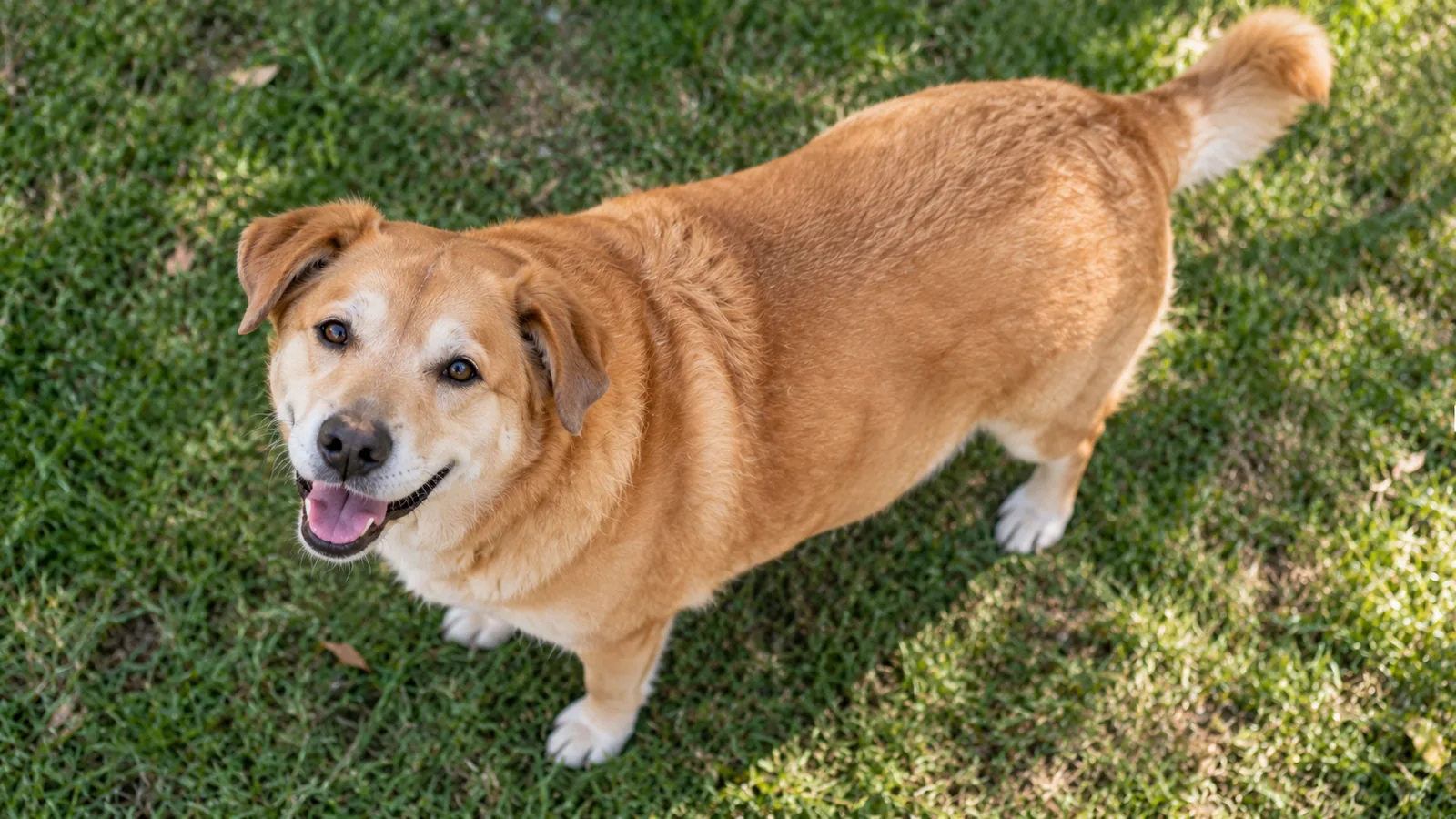
| 6 to 7 | Finding ribs takes a firm push, the waist has gone faint, the belly hangs a little | Overweight, and a portion change now beats a long project later |
| 8 to 9 | Fat covers the ribs entirely, no waist remains, padding sits over the spine and tail base | Obese, with joints and breathing already paying, and we plan the fix together |
Scoring at home takes about a minute. Looking down, the body should pinch in behind the ribs rather than run straight from shoulder to hip. From the side, the belly should rise toward the hind legs instead of hanging level. Lay both palms flat on the rib cage and press lightly: each rib should register as its own ridge, not blur into one smooth surface.
Do this monthly, alongside the parasite prevention dose on the calendar. A Great Pyrenees or a Persian can hide their score under all that fur, and on a thick coated pet your hands outrank your eyes.
If you are not sure what a 5 feels like, ask us to put your hands where ours go. The semi-annual exams in our plans are the easiest place to learn it.
Can a Calorie Calculator Tell Me the Right Portion?
A calorie calculator gets you close to the right portion once you feed it three numbers: today's weight, the body condition score, and the calories per cup printed on the food label. Treat what comes back as a starting point to test for a few weeks, never a figure carved in stone.
- Weigh on the same scale every time: A two-pound gap between your bathroom scale and ours changes the math, especially on a cat.
- Decide whether treats live inside the number or outside it: Most calculators return one daily total. Carve 10 percent out for extras or track the two separately.
- Measure with a real measuring cup or a kitchen scale: The bag's scoop and the kitchen cup are rarely the same size.
- Recheck in three or four weeks: Judge by how your pet looks and moves, not the scale alone.
Needs shift more than families expect. The dog who hikes every weekend in March barely leaves the air conditioning in August, and that alone moves the target by 15 percent. Age shifts it again, and so do arthritis, a new medication, and a second pet who races through meals.
Our preventive care visits are where a calculator result turns into a scoop size, a feeding schedule, and a treat budget your family can live with.
When Does Weight Change Point to Disease Rather Than Diet?
Weight change points to disease often enough that we rule out the medical causes before touching the food: thyroid disease, other hormone conditions, chronic pain that quietly halved the daily activity, sore teeth, and digestive disease. Weight loss nobody planned for earns a workup first, not a diet.
Our in-house bloodwork and ultrasound answer most of those questions without samples leaving the building, and X-rays show the joints when a dog has slowed down.
Cats need a slower hand. Dropping weight fast can trigger hepatic lipidosis, where the liver fails within days. We hold feline loss to about 1 to 2 percent of her body weight each week. A cat who has refused food for 24 to 48 hours needs urgent care during our regular hours, not a smaller bowl.
Pain is the other quiet driver. The arthritic dog who gave up on the ball two years ago burns far fewer calories than the dog in your memory, and every added pound makes the stiffness worse. Medication and laser therapy often come before another portion cut.
Extra weight also causes trouble of its own:
- Joints and spine: Arthritis and intervertebral disc disease both get worse with extra load on the joints, and a dachshund carrying two extra pounds asks more of every disc jumping off the couch.
- Heart and breathing: Systemic hypertension tracks with heavy body condition, wearing on the heart, kidneys, and eyes. Overweight pets, especially flat-faced breeds, struggle to breathe when fat is layered around the chest, and asthma worsens in cats.
- Heat tolerance: Insulation works in both directions. Heavy pets overheat faster from May through September here in North Texas, and a flat-faced breed starts with less airway to cool through.
- Metabolic and urinary: Body fat changes how cells answer insulin. The early signs of diabetes mellitus are a pet drinking and urinating more while losing weight on a normal appetite. Bladder stones and urinary diseases favor pets who move little and drink little.
Overweight pets also struggle more under anesthesia, have higher risks of pancreatitis, and struggle to groom themselves. A lean pet has lower vet bills and lives a longer, more comfortable life.
What Keeps the Weight Off Once It's Gone?
What keeps the weight off is rechecking the plan. A portion that fit in March stops fitting by August, because activity, weather, age, and health all move the target. For most adult dogs and cats, a weight and body condition check twice a year catches the drift early.
Once pets reach their senior years, our veterinarians want eyes on them every six months. A two-pound swing at 11 says far more than the same swing did at 4.
Are Prescription Weight-Loss Diets Different From "Light" Food?
Prescription weight-loss diets differ from over-the-counter light food in one concrete way, and that is testing. Therapeutic diets go through feeding trials proving that pets shed fat while lean muscle stays put, and light formulas carry no such requirement.
Protein stays high while calories drop, and controlled fiber lets a pet finish a smaller portion and still feel full. Many add L-carnitine to support fat metabolism during the loss phase.
We stock the diets we recommend through our in-house and online pharmacy, keeping the food from running out halfway through a plan that is finally working.
How Do I Feed Less Without a Dog Who Begs All Evening?
You can feed less without an evening of begging by making the smaller portion take longer to earn. Work stretches the meal out, and your pet finishes feeling like they did something rather than missing something.
Weight loss in dogs comes easier when the measured portion goes into a puzzle feeder or gets scattered across the yard. A slow-feed bowl does a smaller version of the same job.
Helping a cat lose weight usually means several small measured meals, puzzles she has to hunt, and a few minutes of wand play before each one. A portion set on top of the cat tree adds a climb to every meal.
Weight and Feeding Questions We Hear Most
Is my cat begging because they're hungry, or because they're bored?
A cat who begs is usually some of both. Cats ask for food the way they ask for everything else, by finding whoever answers. If the begging tracks your schedule rather than a real gap between meals, a wand toy or food puzzle answers it better than the bag does. A cat who never begged and now hounds you for food is a different story, and that one earns a visit to check thyroid levels and blood sugar.
Can I just feed a third less of the food we already have?
Feeding a third less of a regular maintenance diet cuts the protein, vitamins, and minerals right along with the calories, and your pet ends up short on nutrients and still hungry. Trimming 10 percent is usually safe to try for a few weeks, and start with the treats. Bigger reductions belong on a food built for weight loss, where the nutrition holds steady while the calories come down. Bring us a current weight and a score, and we will tell you which situation you are in.
How do I put one pet on a diet when the others eat whatever they want?
Feeding one pet a diet in a full house works once meals stop being communal. Separate rooms with the doors closed for 15 minutes is the simplest fix, and pets learn the routine fast. A cat can eat up high where a dog cannot follow, and a microchip-activated feeder handles the cat-to-cat version. Free feeding has to end for everyone, because a bowl sitting out all day makes any individual plan impossible to track.
Reaching a Healthy Weight Without Doing It Alone
A dog at the right weight gets up off the floor more easily, and a cat at the right weight can groom back to the base of her tail again. Both tend to get more good years out of the arrangement. Saying no to a pet who has perfected the starving look is hard, and we will not pretend otherwise. Small changes held steady move the number, not heroic ones.
You do not have to work out the math by yourself. Schedule a weight consultation at Woodland Springs Veterinary Hospital in Fort Worth, and we will start with a hands-on score, a realistic goal, and a feeding plan that fits the household you actually have.